
Search Georgia Deed Records
Georgia deed records are public documents that show who owns land, how property changed hands, and what liens or claims exist on real estate. The Clerk of Superior Court in each of the state's 159 counties keeps these records. The Georgia Superior Court Clerks' Cooperative Authority runs a statewide online system called GSCCCA that lets you search deed records from any county in one place. Whether you are looking for a warranty deed, a quit claim deed, a lien filing, or a plat map, Georgia deed records are open to the public and available online from January 1, 1999 forward.
Georgia Deed Records Quick Facts
Georgia Deed Records Through GSCCCA
The Georgia Superior Court Clerks' Cooperative Authority is the main system for accessing deed records across the state. The GSCCCA was established under O.C.G.A. §15-6-94 to give the public a single place to find real estate records from any of Georgia's 159 counties. The deed index holds property transaction data from January 1, 1999 forward. You can search by buyer name, seller name, book and page number, or property location. Every county feeds its records into this one statewide system.
The GSCCCA homepage is where deed record searches begin for most users.
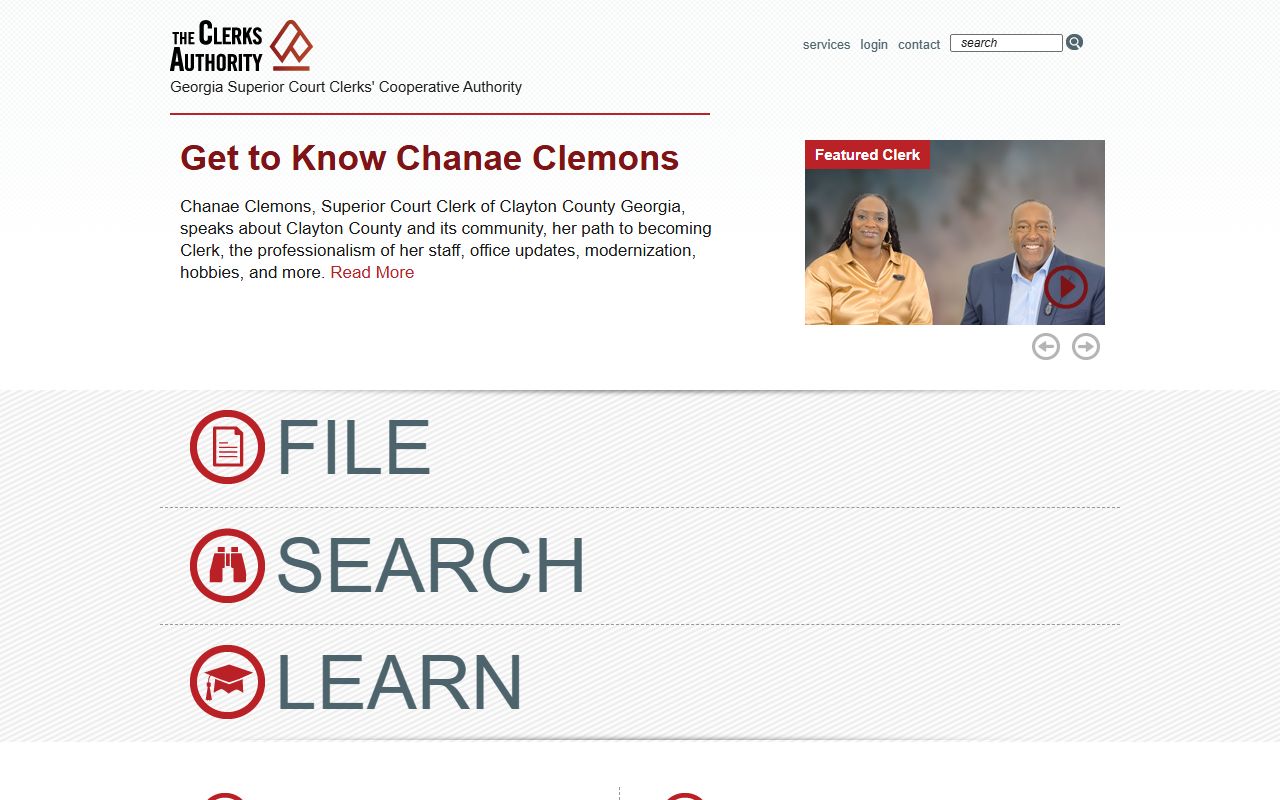
Registered users can search deed indexes, download documents, and manage filings at gsccca.org.
The GSCCCA main office sits at 1875 Century Boulevard, Suite 100, Atlanta, GA 30345. You can reach them by phone at (404) 327-9058. Technical support is available toll-free at 800-304-5174. Support staff work Monday through Friday, 7:30am to 6:00pm. For email help, write to Help@gsccca.org. The system covers every county in the state and is the first place to check for Georgia deed records before going in person to a courthouse.
The GSCCCA services page lists every tool available for deed record access in Georgia.
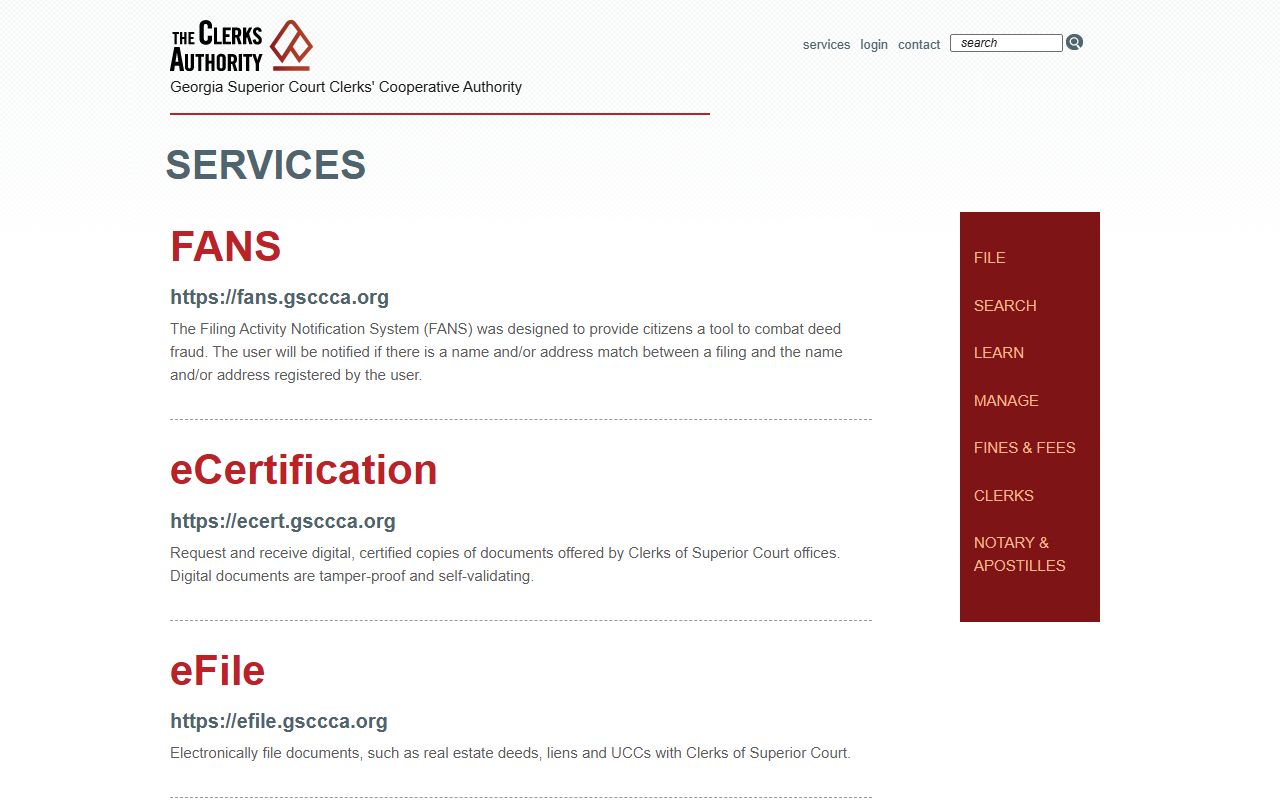
Services at gsccca.org/services include eFiling, eCertification, FANS fraud monitoring, and the eLearn training platform.
Search Georgia Real Estate and Lien Records
The GSCCCA runs two focused search tools that are key to any Georgia deed records search. The real estate search at search.gsccca.org/RealEstate/ lets you look up property transactions by grantor or grantee name across all 159 counties. Each result shows the seller, buyer, property location, book and page number, and any related lien data. This is the fastest way to find a deed record without going to the courthouse. Records date back to January 1, 1999.
The real estate search tool is the main portal for finding Georgia deed records online by name or property.
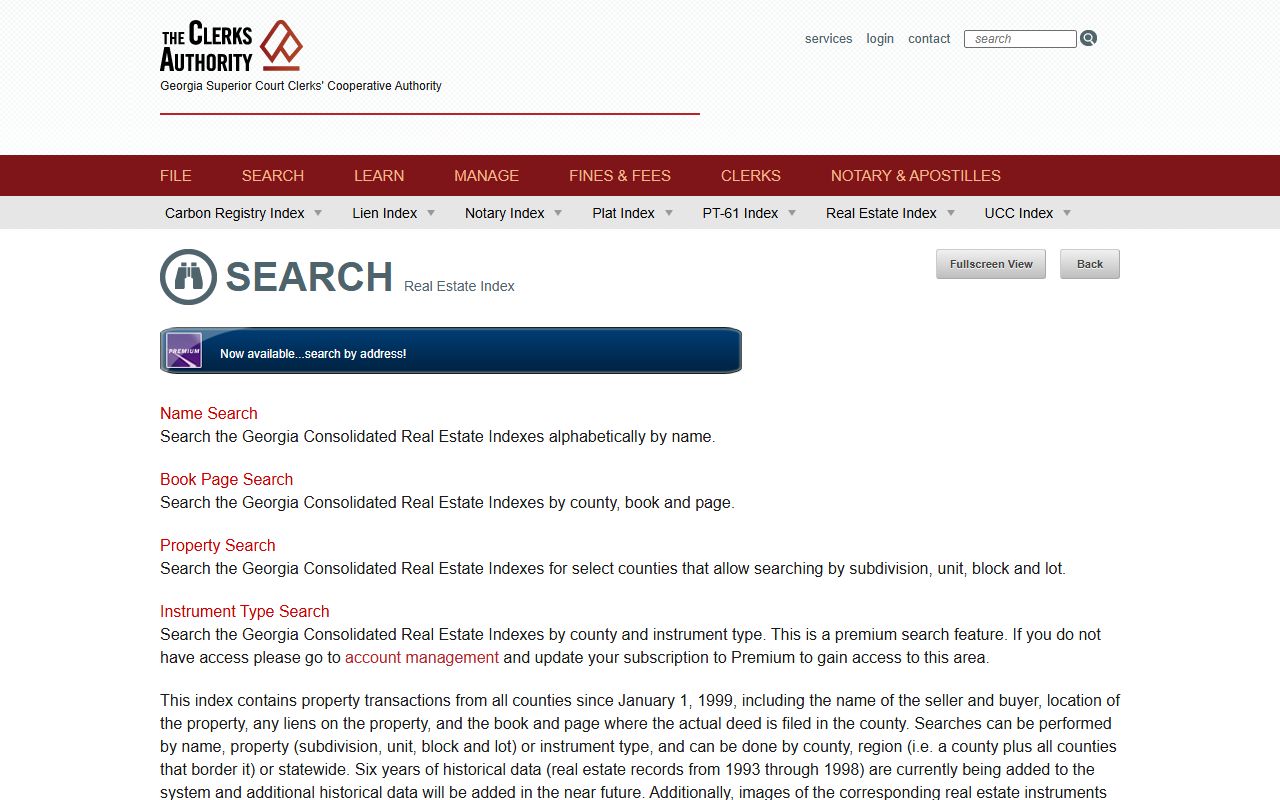
Search the real estate index at search.gsccca.org/RealEstate/ to find Georgia deed records from any county since 1999.
Georgia also has a lien search tool separate from the deed index. The lien name search covers real estate and personal property liens filed under O.C.G.A. §44-2-2. The lien database went live January 1, 2004 under HB 1582. You can search by debtor name to find unpaid tax liens, materialmen liens, or judgment liens before you buy or transfer property. A lien on a property must be cleared before a deed can go through clean title in Georgia.
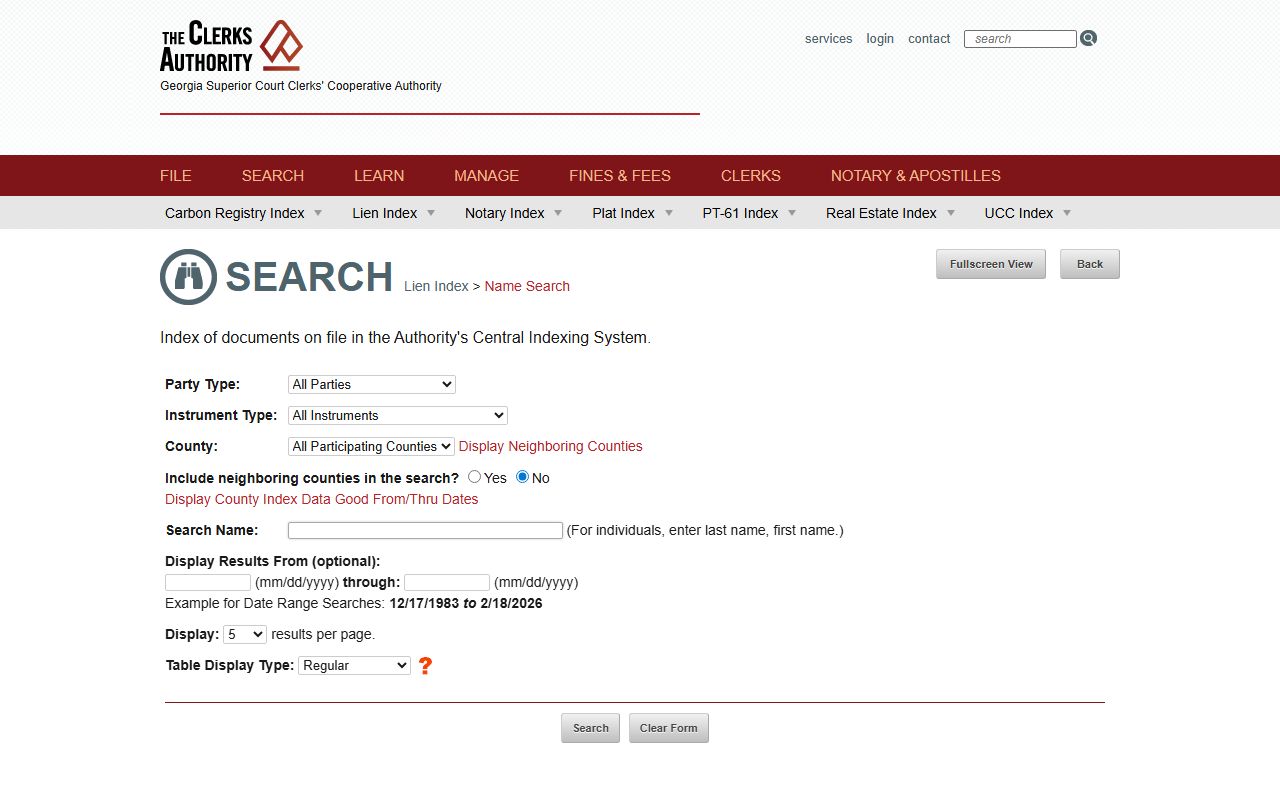
The lien name search at search.gsccca.org/lien/namesearch.asp is a free way to check for encumbrances before a Georgia property transfer.
Note: The GSCCCA deed index covers records from 1999 forward. For older Georgia deed records, you must contact the county clerk directly or visit in person.
GSCCCA Account Types for Georgia Deed Access
Viewing the deed index on the GSCCCA site does not require an account. But printing deed documents does. Account pricing changed effective July 1, 2025. A Regular account costs $14.95 per month plus $0.50 per printed page. A Premium account runs $29.95 per month plus $0.50 per page. Both give full access to the deed index, lien index, plat index, PT-61 records, and UCC filings across all 159 Georgia counties.
A Single-Use account is available if you only need access once. It costs $5.00 to activate and gives four hours of access. Printing is still $0.50 per page and is charged to your card automatically. Set up any account type at account.gsccca.org. UCC Certified searches cost $15.00 per debtor name search with a 24-hour turnaround.
The service descriptions page at account.gsccca.org/ServiceDescriptions.asp breaks down every index available for Georgia deed records.
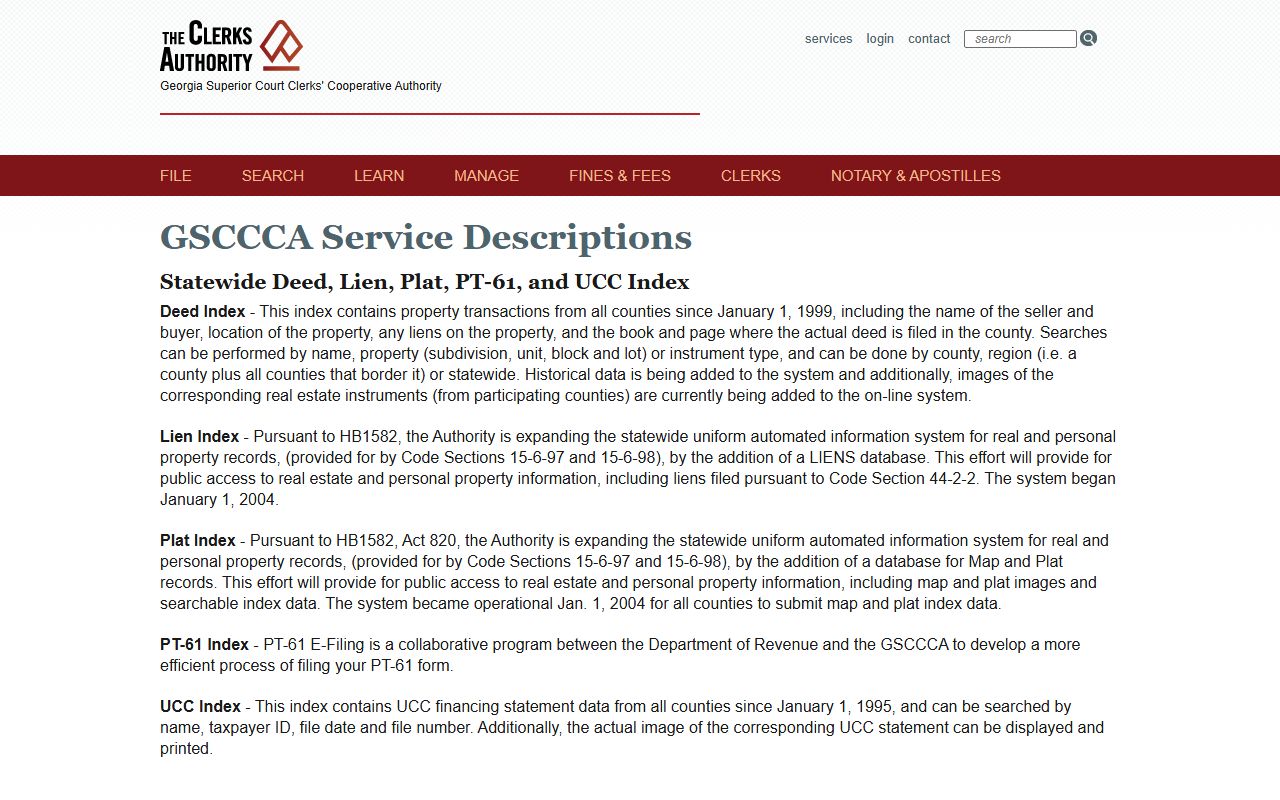
The deed index, lien index, plat index, PT-61 index, and UCC index are all available under a single GSCCCA account for Georgia deed records.
Account management is handled at the dedicated portal for GSCCCA subscribers.
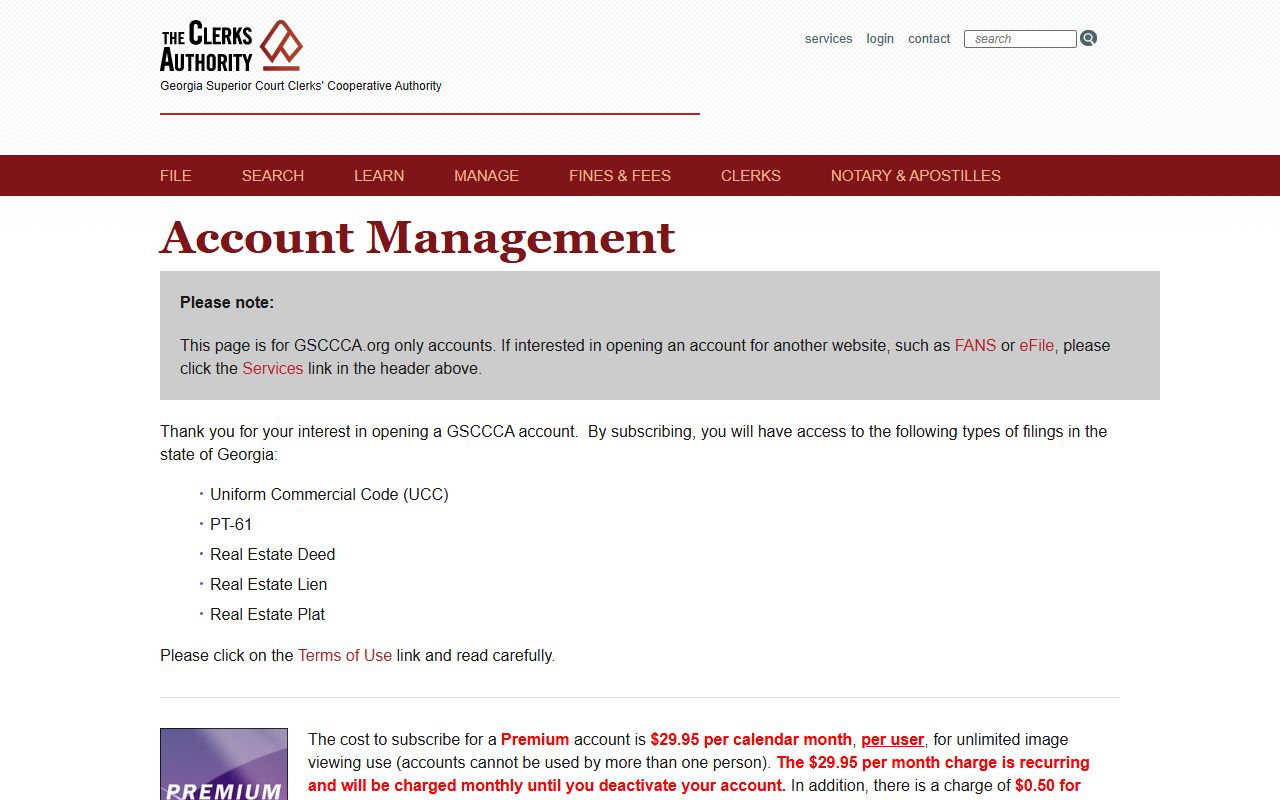
Manage your subscription, billing, and user settings at account.gsccca.org for access to Georgia deed records from any county.
How to Record Georgia Deed Records Online
Georgia offers electronic recording for deed documents through the GSCCCA eFile portal. You can submit real estate deeds, liens, and UCC documents to any Clerk of Superior Court in the state through this system. Third-party eRecording vendors like Simplifile, ePN, and CSC also work with Georgia clerks. eRecorded deed documents typically process in two to three business days. Paper submissions take up to four weeks.
The GSCCCA eFiling portal is where you submit Georgia deed documents electronically to any county clerk.
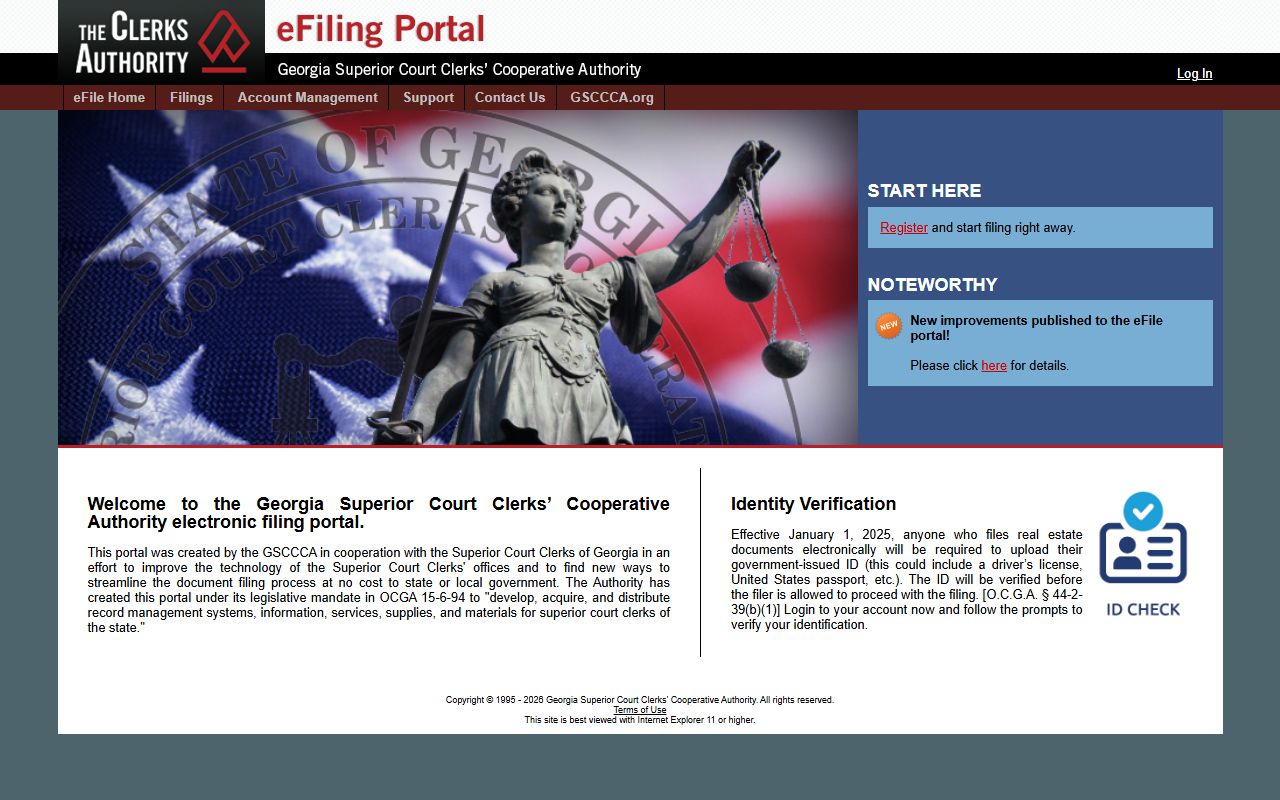
The eFile portal at efile.gsccca.org accepts real estate deeds, liens, plats, and UCC filings for all Georgia counties.
Before you file any deed record in Georgia, your document must meet state requirements. O.C.G.A. §44-2-14 requires all deeds to be properly attested or acknowledged. The name and mailing address of the recipient must appear on the first page. Two witnesses are required, and the deed must be notarized with a seal. Documents that do not meet these rules get rejected at the clerk's office.
A PT-61 form must accompany any warranty deed or quit claim deed that conveys property. You complete the PT-61 online at gsccca.org. Separate checks are required for the recording fee, transfer tax, and intangible tax when paying in person. Some counties also require a tax parcel identification number on the deed under HB 1036. Check with the specific county clerk before filing to confirm local requirements.
FANS Deed Fraud Alert System in Georgia
The Filing Activity Notification System, known as FANS, is a free service from the GSCCCA that helps protect Georgia property owners from deed fraud. When you sign up, you enter your name and address. If a new deed or other filing matches that information, FANS sends you an alert right away. Deed fraud, sometimes called house stealing, involves someone filing a fake deed without the owner's knowledge. FANS gives you early warning so you can act fast.
The FANS system at fans.gsccca.org explains how the deed fraud alert service works for Georgia property owners.
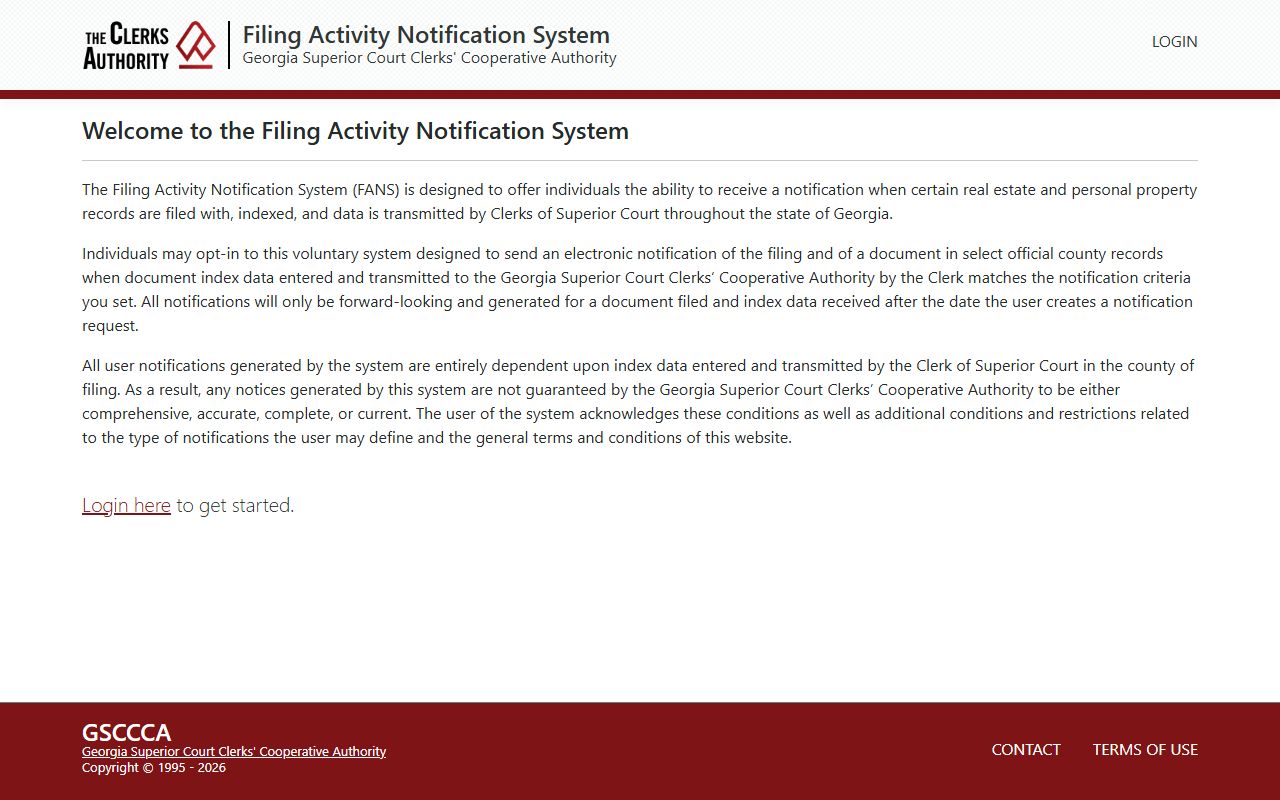
FANS is free to use and open to any Georgia property owner at fans.gsccca.org. Sign-up takes just a few minutes.
Get Certified Copies of Georgia Deed Records
The GSCCCA eCertification portal at ecert.gsccca.org lets you get certified copies of Georgia deed documents any time of day without going to the courthouse. Digital certified copies are tamper-proof and self-validating. They carry the same legal weight as paper certified copies from the county clerk. This is the easiest path to a certified deed record in Georgia when you need it for a refinance, title search, or legal matter.
The eCertification portal at ecert.gsccca.org makes certified Georgia deed records available around the clock.
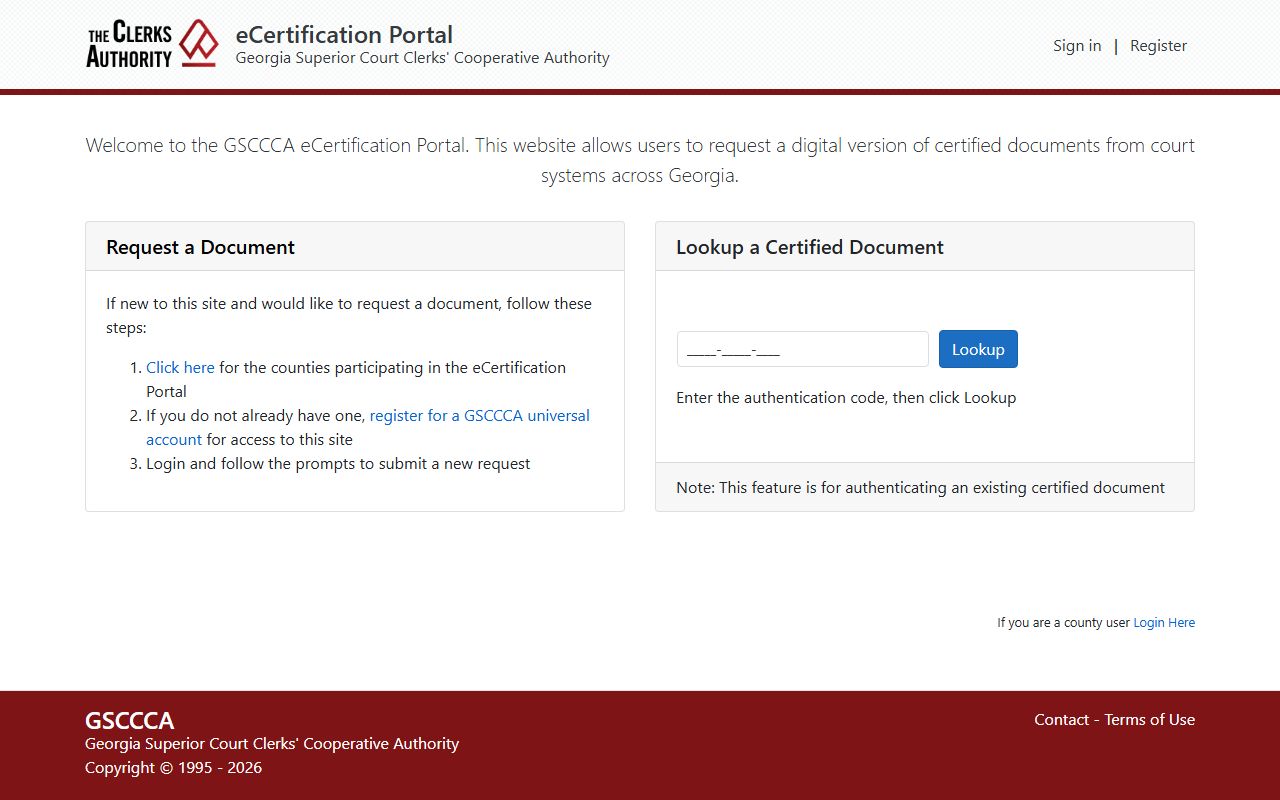
Request certified deed copies at any hour through ecert.gsccca.org for property records from any of Georgia's 159 counties.
If you prefer to get copies in person, go to the Clerk of Superior Court in the county where the deed was recorded. Copy fees across most of Georgia run $0.50 per page for uncertified copies. Certified copies are typically $2.50 for the first page plus $0.50 for each additional page. Call the county clerk ahead of time to confirm their current fees.
Georgia Deed Records Training Resources
The GSCCCA runs an online training platform called eLearn at elearn.gsccca.org. Courses cover how to use the deed records system, how to file documents correctly, and how the notary public process works in Georgia. The platform is open to anyone who works with property records, including attorneys, real estate agents, title companies, and court clerks. Training helps reduce errors that cause deed filings to get rejected.
The eLearn training platform at elearn.gsccca.org has courses on Georgia deed records and the GSCCCA filing system.
Free and paid training is available at elearn.gsccca.org for anyone who needs to learn the Georgia deed records system from scratch or sharpen existing skills.
Georgia Deed Records Laws and Statutes
Several statutes govern how deed records are created, filed, and accessed in Georgia. The core recording requirements come from O.C.G.A. §44-2-14, which sets out what a deed must contain to be recorded at a county clerk's office. The Uniform Real Property Electronic Recording Act at O.C.G.A. §44-2-35 covers online deed filing and sets standards for electronic signatures and notarization. Rules for how clerks accept electronic documents come from O.C.G.A. §44-2-39.
Plats follow O.C.G.A. §15-6-67, which requires all plat maps to be filed electronically since January 1, 2017, under HB 1004. Lien filings fall under O.C.G.A. §44-2-2. Open access to deed records is protected by the Georgia Open Records Act at O.C.G.A. §50-18-70, which says public records must be produced within three business days of a request. No one needs a reason to request Georgia deed records. The records belong to the public.
The GSCCCA search page lists every record type available under Georgia deed records law.
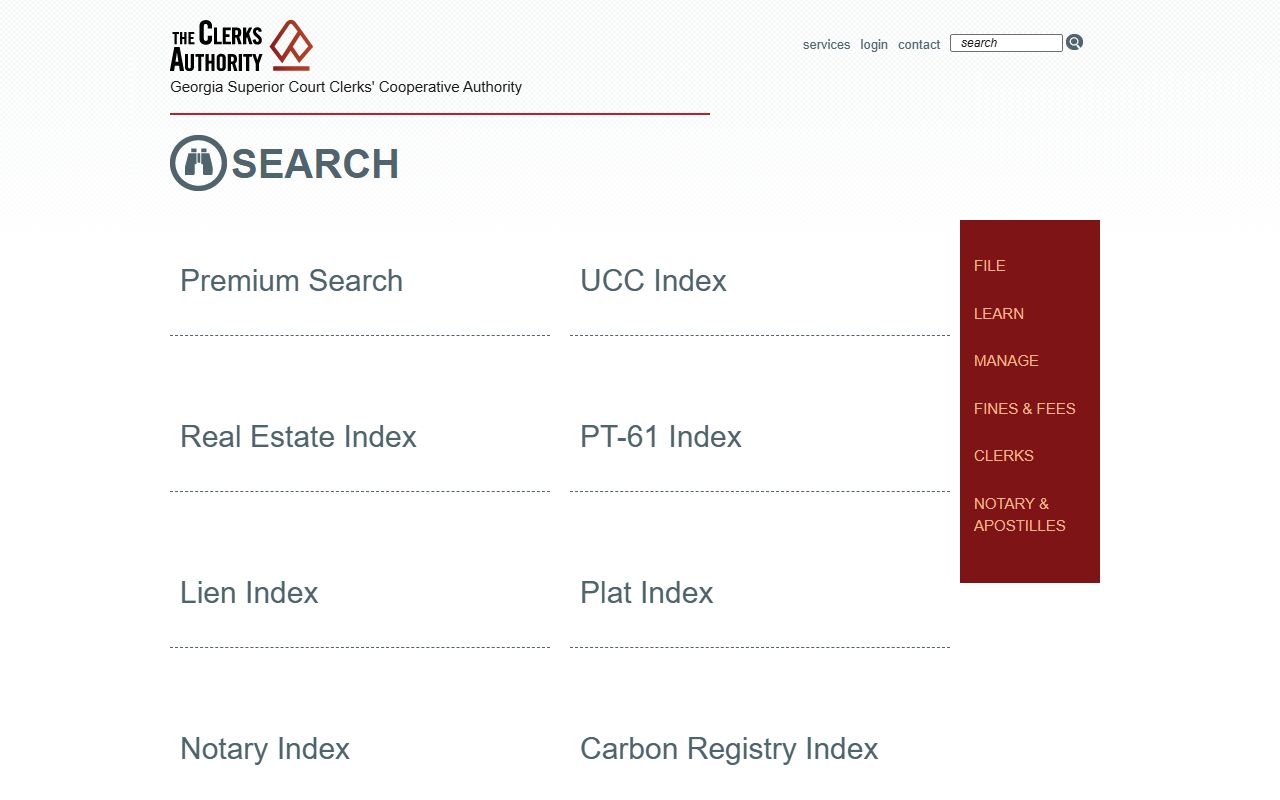
The GSCCCA search page at gsccca.org/search gives access to the deed index, lien index, plat index, PT-61 index, and UCC index for all Georgia counties.
One thing to keep in mind: the clerk's office cannot give legal advice under O.C.G.A. §15-19-51. Staff can help you find deed records and make copies, but they cannot tell you how to prepare a deed or what a document means legally. If you need help with a deed in Georgia, consult a licensed real estate attorney.
Find Your Georgia County Clerk for Deed Records
Every county in Georgia has a Clerk of Superior Court who keeps deed records for that area. The GSCCCA maintains a full directory of all 159 county clerks at gsccca.org/clerks. Each clerk page shows the office address, phone number, fax, and hours. The standard recording fee is $25.00 per document statewide under O.C.G.A. §15-6-77. Most Georgia counties also charge $0.50 per page for copies and $2.50 for the first page of a certified copy.
The GSCCCA contact page has phone and email info for the main Georgia deed records support office.
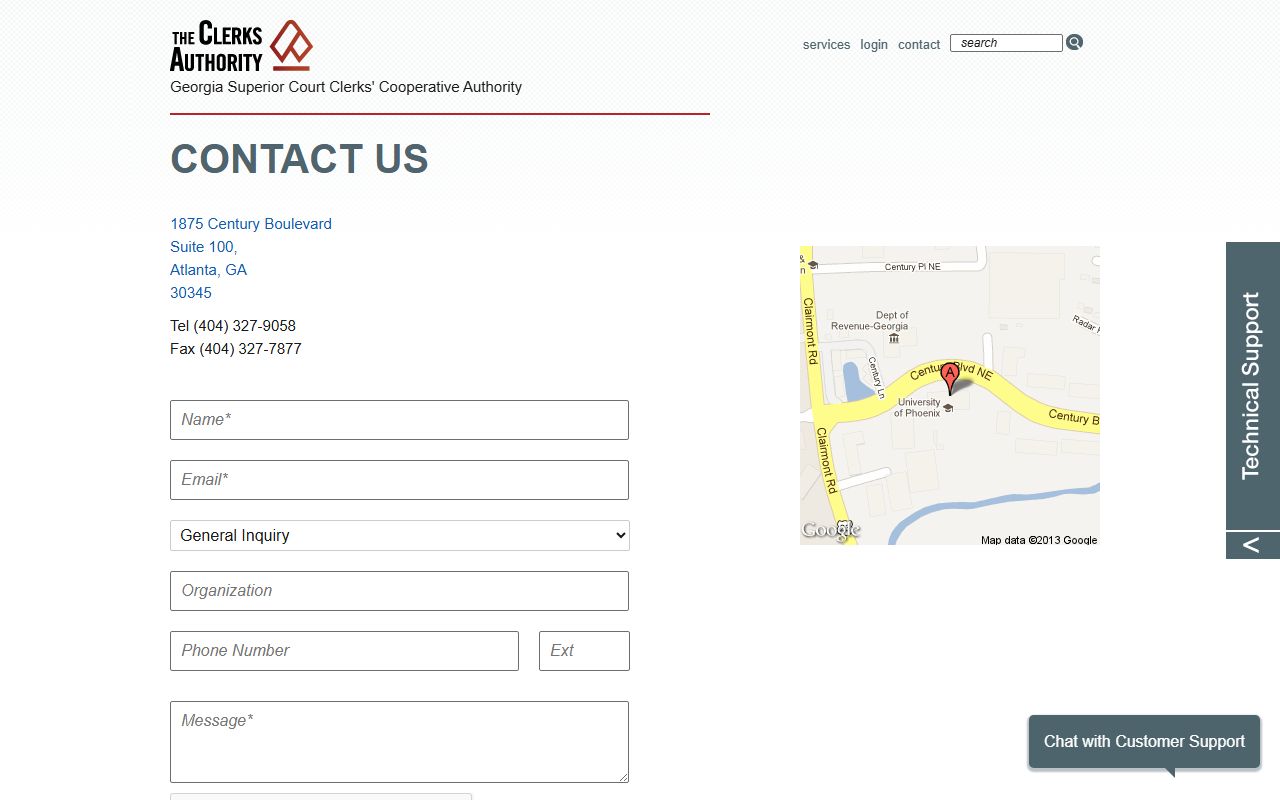
Call (404) 327-9058 or toll-free at 800-304-5174 with questions about the Georgia deed records system. You can also email Help@gsccca.org.
The county clerks directory is the best single resource for finding any Georgia deed records office.

The full clerk directory at gsccca.org/clerks lists all 159 Georgia counties with addresses, phone numbers, and direct links to each county's GSCCCA page for deed records.
Deed Records by Georgia County
Each of Georgia's 159 counties keeps its own deed records through the local Clerk of Superior Court. Select a county to find contact details, filing rules, and online search tools for deed records in that area.
Georgia Deed Records by City
Cities in Georgia do not keep their own deed records. All property transfers file with the county clerk. Select a city to find the right county office and online tools for deed records in that location.